.png)

Body worn cameras – from video recording to an integrated security system
Body worn cameras are part of a larger security system
A body worn camera allows you to record video and audio directly from the perspective of someone on the scene.
In practice, however, the device itself is just one part of the overall solution.
It is only when planning the deployment that key questions arise: what happens to the footage after an intervention ends?
Where is it uploaded and stored? Who can access it?
How do you combine body worn camera footage with recordings from existing surveillance?
And how do you manage the solution when the number of devices grows from a few to dozens or hundreds?
That is why an effective body worn camera deployment should be designed as part of an organization's entire security environment – rather than as a purchase of individual devices.
How does a body worn camera system work?
Depending on the chosen architecture, the entire process involves several stages:
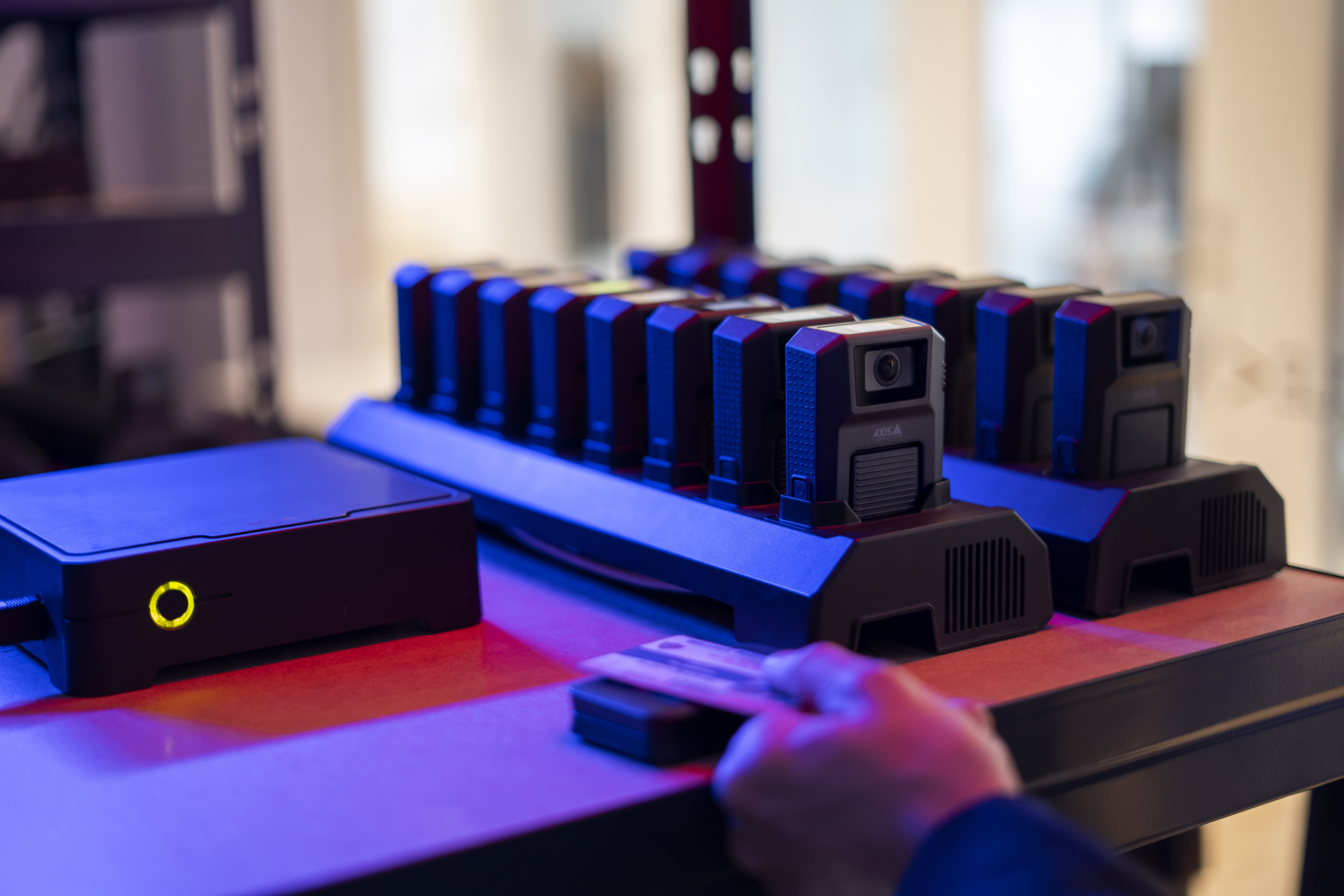
Body worn camera → docking station → server or cloud → VMS → operator
Each of these elements is responsible for a different part of the process: from recording the footage, through its transfer and secure storage, to accessing, reviewing, and further analyzing the recordings.
This means that when designing the solution, you must consider not only the technical specifications of the cameras, but also user workflows, existing IT and security infrastructure, data retention policies, and requirements for accessing the materials.

What needs to be planned before deploying body worn cameras?
A well-designed solution should address an organization's needs as early as the system architecture design stage.
In practice, you should define, among other things:
- device allocation and management procedures – who uses the camera, how it is assigned to a user, and what happens to it after a shift ends,
- recording transfer process – when and how footage is uploaded to the system,
- data storage location and methods – in compliance with organizational security and retention requirements,
- user permissions – who is authorized to view, export, or manage recordings,
- integration with existing systems – primarily with Video Management Software (VMS),
- managing multiple devices – including configuration, user management, updates, and ongoing maintenance.
This ensures that the body-worn camera becomes part of a structured process rather than just another isolated data source.
Axis body-worn cameras as part of an existing security environment
At squareTec, we implement body-worn camera solutions from Axis Communications as part of a broader security architecture.
This approach allows you to leverage your organization's existing infrastructure instead of creating a separate system just for body-worn cameras. Footage captured by users can be managed alongside recordings from fixed cameras, and the solution can be integrated with your current VMS.
This is particularly important for organizations that already use an extensive surveillance system and want to expand its capabilities to include video captured from the perspective of an employee directly at the scene.
What are the benefits of using body-worn cameras?
Greater situational context
A fixed camera monitors a specific area, whereas a body-worn camera captures the situation from the perspective of the person involved in the event.
This allows the footage to complement traditional surveillance, providing information that cannot be seen from cameras mounted on buildings or infrastructure.
Reduced risk of losing critical footage
Select Axis camera models offer a pre-recording feature. This allows you to save a portion of the footage captured immediately before recording is officially triggered.
In practice, this can be crucial in situations where an incident starts suddenly and the user does not have the opportunity to start recording immediately.
Secure handling of recordings
Implementation should cover the entire lifecycle of the footage – from the moment of recording, through transfer and storage, to access, review, and export.
This approach allows for better control over access to materials and reduces the risks associated with unauthorized use or loss.
Integration with VMS
Connecting body-worn cameras to an existing video management system allows you to treat different video sources as part of a single environment.
Operators do not need to work with a completely separate system just because some of the footage comes from cameras worn by staff.
More efficient device fleet management
When dealing with a large number of cameras, managing the entire environment becomes just as important as the functionality of the devices themselves.
A centralized approach to configuring devices, users, and access to footage makes it easier to maintain consistent system operating policies, even in organizations with multiple locations.
How does squareTec implement body-worn cameras?
We begin the solution implementation by analyzing the environment in which the cameras will operate. It is important to us not only that which device to choose, but above all how it should function within the entire system.
The process may include:
1. Analysis of needs and existing infrastructure
We learn about the organization's workflow, the security systems in use, and the requirements for handling and storing footage.
2. Selection of devices and solution architecture
We select the appropriate camera models and other system components for the specific application and technical environment.
3. Integration with existing systems
We connect the solution to the organization's infrastructure, including VMS systems, so that body-worn cameras can function as part of the existing security environment.
4. Configuration and deployment
We configure devices, users, permissions, and other solution elements, and then conduct tests before going live.
5. Training for users and administrators
We provide the knowledge necessary for the proper use of the cameras and the management of the entire solution.
6. Post-implementation support
We assist in maintaining and further developing the system as the organization's needs evolve.
Why does integration matter?
Purchasing body-worn cameras is a relatively simple step. A much greater challenge is building a solution that will work efficiently in daily operations while fitting into the existing security architecture.
That is why at squareTec we view body-worn cameras not as standalone devices, but as part of a complete security system.
We combine technology selection, integration, configuration, deployment, and training to ensure the solution meets the actual needs of your organization—both today and as it scales in the future.
Image credits: Axis Communications